Puzzling

You might just know that I love puzzles. I always have. My favorite one during childhood was Verticalville II. Elia, my sister, and I must have completed it two dozen times.

A few years back, after the pneumonia-induced staycation that ushered in my renewed mania for puzzles, I managed to find on eBay, an unopened, original Verticalville II. I bought it immediately, ostensibly for the boys.

Oliver doesn't much care for puzzles, but Jack is a big fan, and though he and I prefer 1,000-piecers, we've done Verticalville II -a mere 500- twice or three times since I bought it. He loves it like I do, because it's challenging but not too much so and delightfully illustrated.

Nanny enjoyed puzzles before her hands and eyes failed her. She loved landscapes: fall foliage, say, or a Christmas scene. Those aren't my bag, but since she died, the kids, Mom and I have put a few of her old ones together during visits to Lake Charles, and I always feel so happy to do so. I miss her.

I used to puzzle in my basement, but after Nutmeg employed two box tops full of inside pieces as his litter box, I've moved upstairs, by a window in my front room. My one nice room, as the kids know. There sits a decent-enough card table and a much nicer folding chair that doubles as an extra dining seat when we have more than six for dinner. 

Last night, Jack and I wrapped up this one: Fancy Buttons or some such name, a 1,000-piece by Ravensburger. It was really a near-perfect puzzle. Tough but not like the one of the snowy owl that made you want to tear your hair out and pitch the endless white pieces into the nearest fireplace. Colorful and interesting enough to keep you engaged, even during the periods of slow progress.
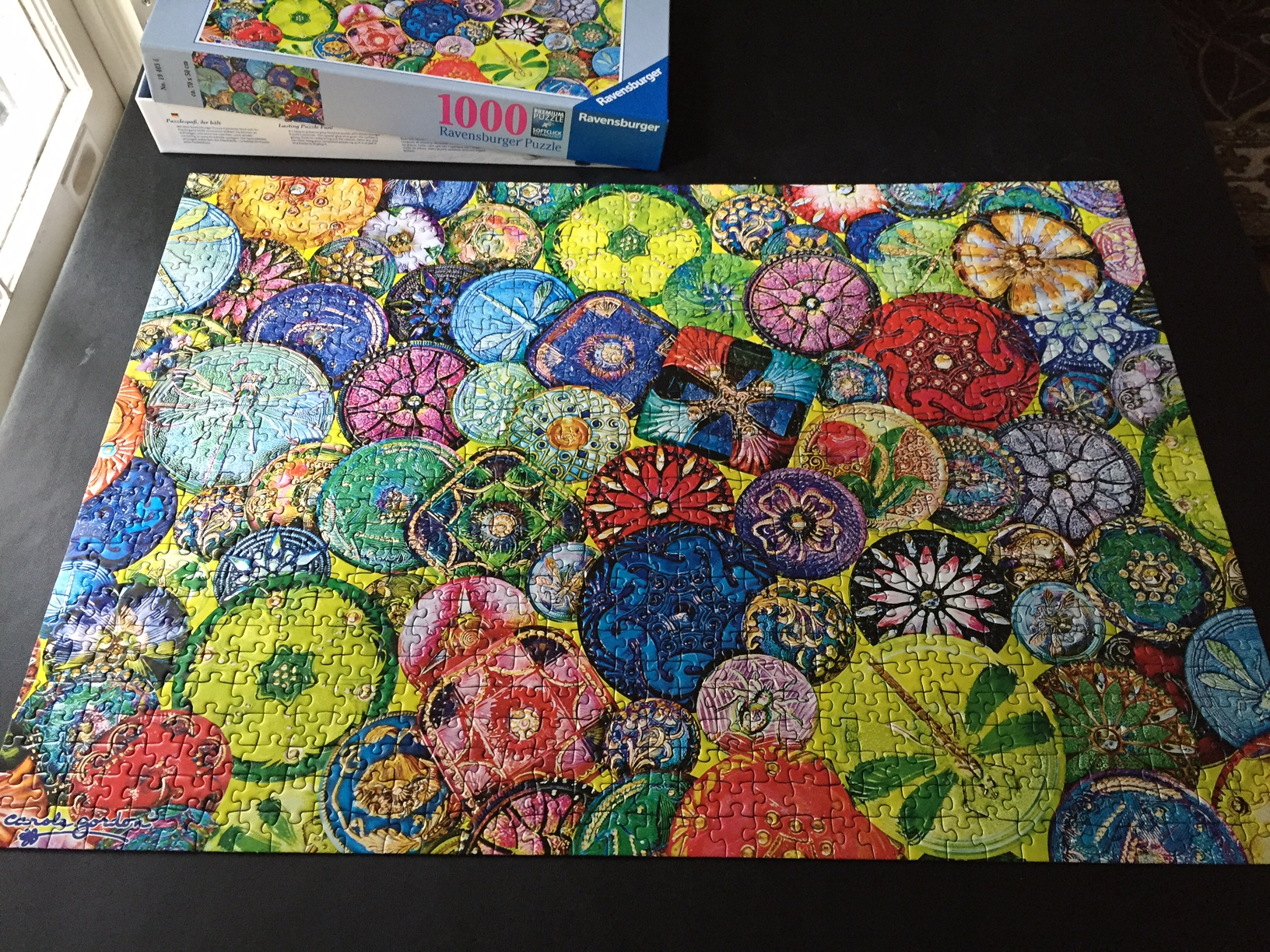
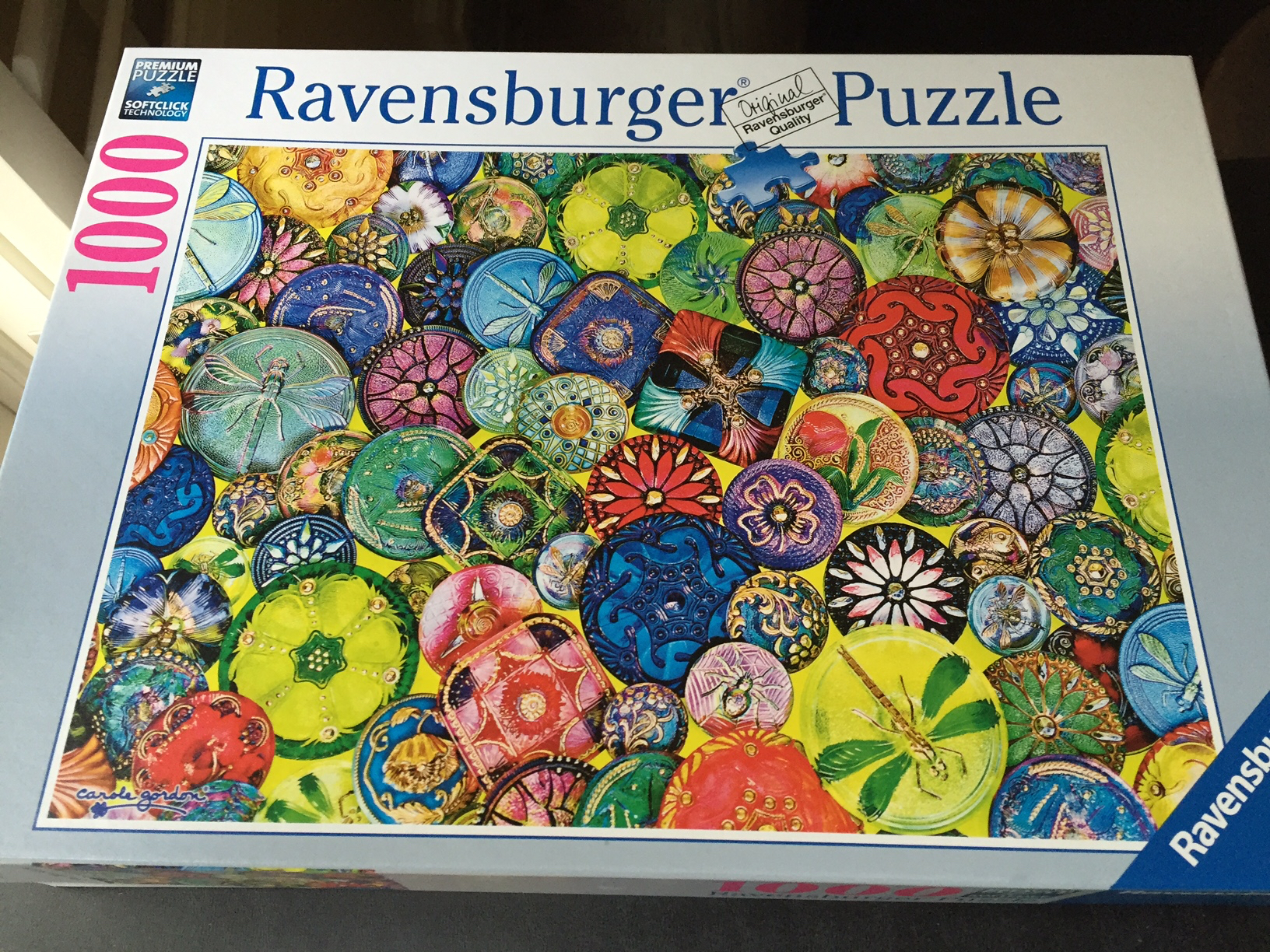
That's one thing I like about puzzles. They don't mind waiting if I need to take a break from them. Nothing is urgent except, perhaps, for my desire to get back to the one at hand. 

Puzzles can take full concentration or allow me to feel mindfully absent. Sorting edge pieces, for example, takes little effort, but figuring out which of four identical green circles this or that piece fits into requires a great deal more focus.

While puzzles are both random and orderly, it is always true that many pieces comprise the whole, and absent the box-top photo, you're never completely sure about what the jig is going to look like until you slot the last piece in.

Isn't that rather like life? And parenting?

Clues litter the paths we can take. Colors, shapes, parts of words and phrases, experiences, mistakes. All guide us forward, clearly or not remotely so. Some days feel successful, some feel like trapdoors that push us back to the starting point. Sometimes puzzles, life, are frustrating. We throw up our hands and stalk off. But sometimes, we hit our strides, and our shoulders life with the sense of accomplishment.

We move forward, with blind faith, determination, youthful joy and even some trepidation about what might appear when we slot the next piece correctly. When we reach the next milestone, successfully teach or learn the next skill. 

While some puzzles are whimsical flights of fancy, not unlike a choose-your-next-step adventure book, others are lithographs of life, snapshots of time and place taking shape before your eyes.  

The obvious difference of course is that a puzzle, once done, can be broken apart and tucked away for later, left to gather dust on a shelf. A goal accomplished.

Life isn't so neat. Parenting isn't ever really done. But in both, the beautiful parts are essential to the whole, and I find that lovely indeed.
Evenings with Ta-Nehisi Coates and Ruth Reichl

I love living in a city that teems with cultural opportunities. This past week felt especially rich, and although I cannot wait, literally, to go to bed tonight, the fatigue is worth it.

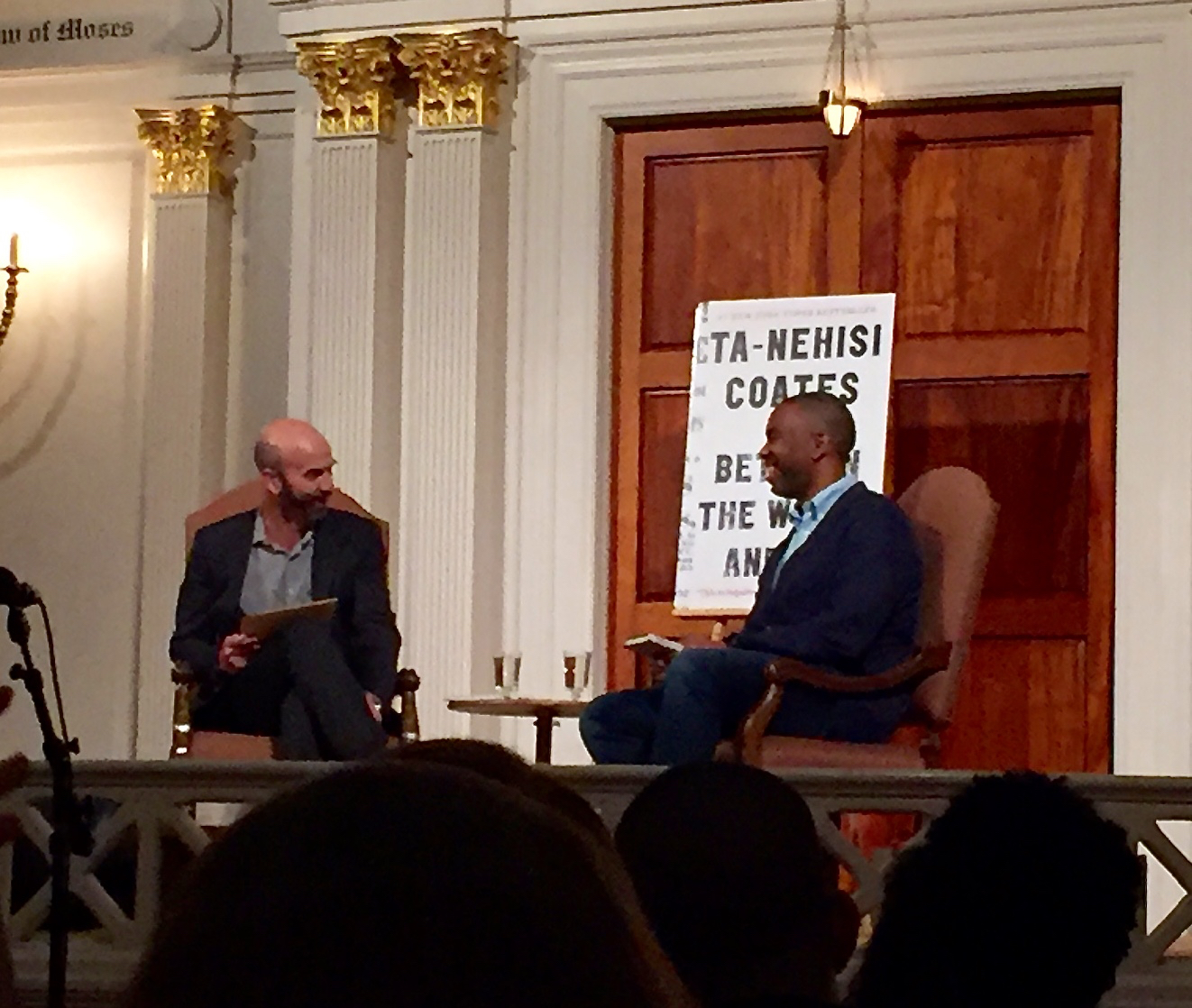
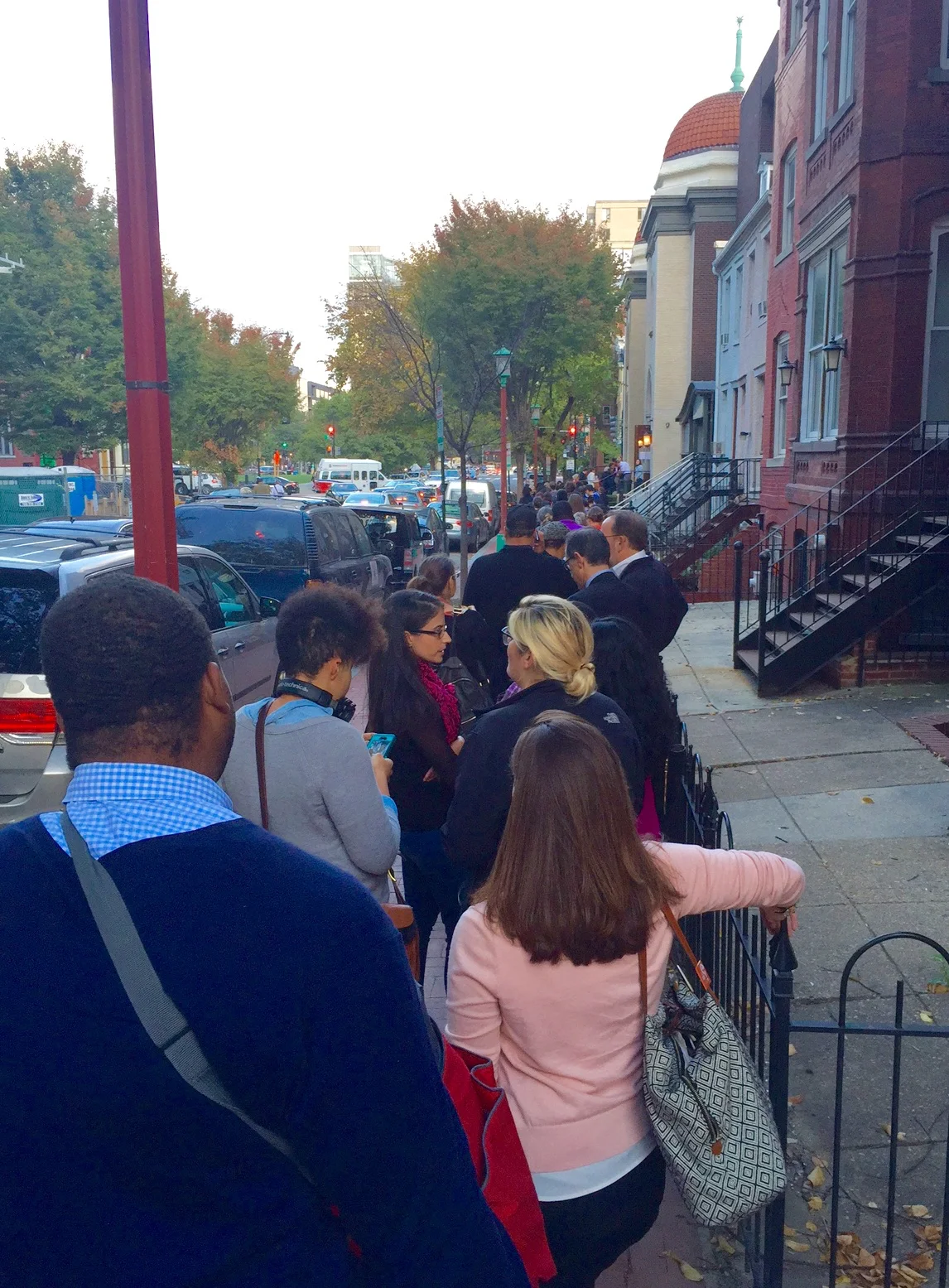
On Wednesday, not two hours after traffic mayhem, swimming lessons, gobbling pizza, hopping the Metro and arriving in Chinatown, I made it to the historic Sixth & I synagogue where an energetic line stood waiting for the doors to open, 

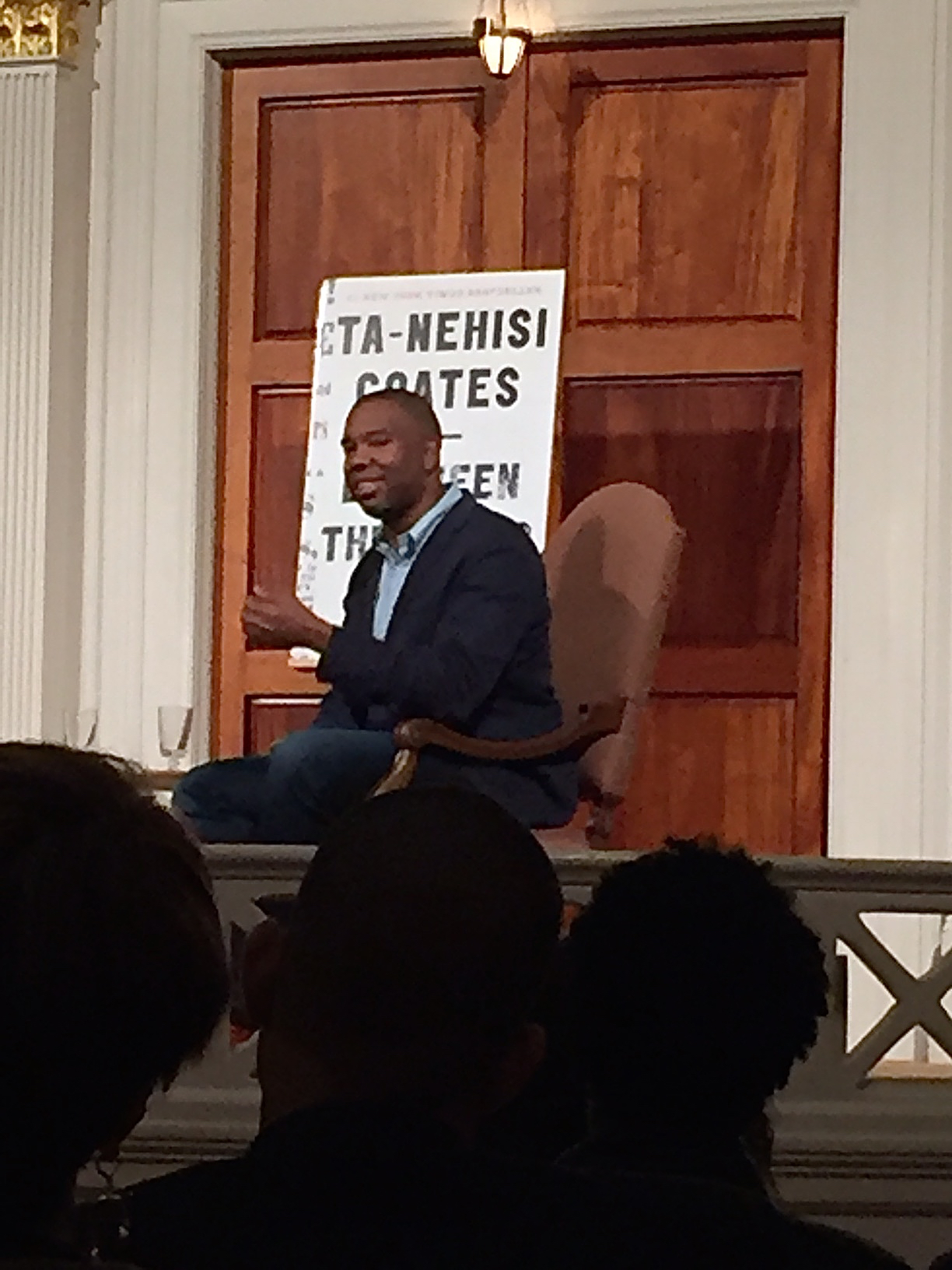
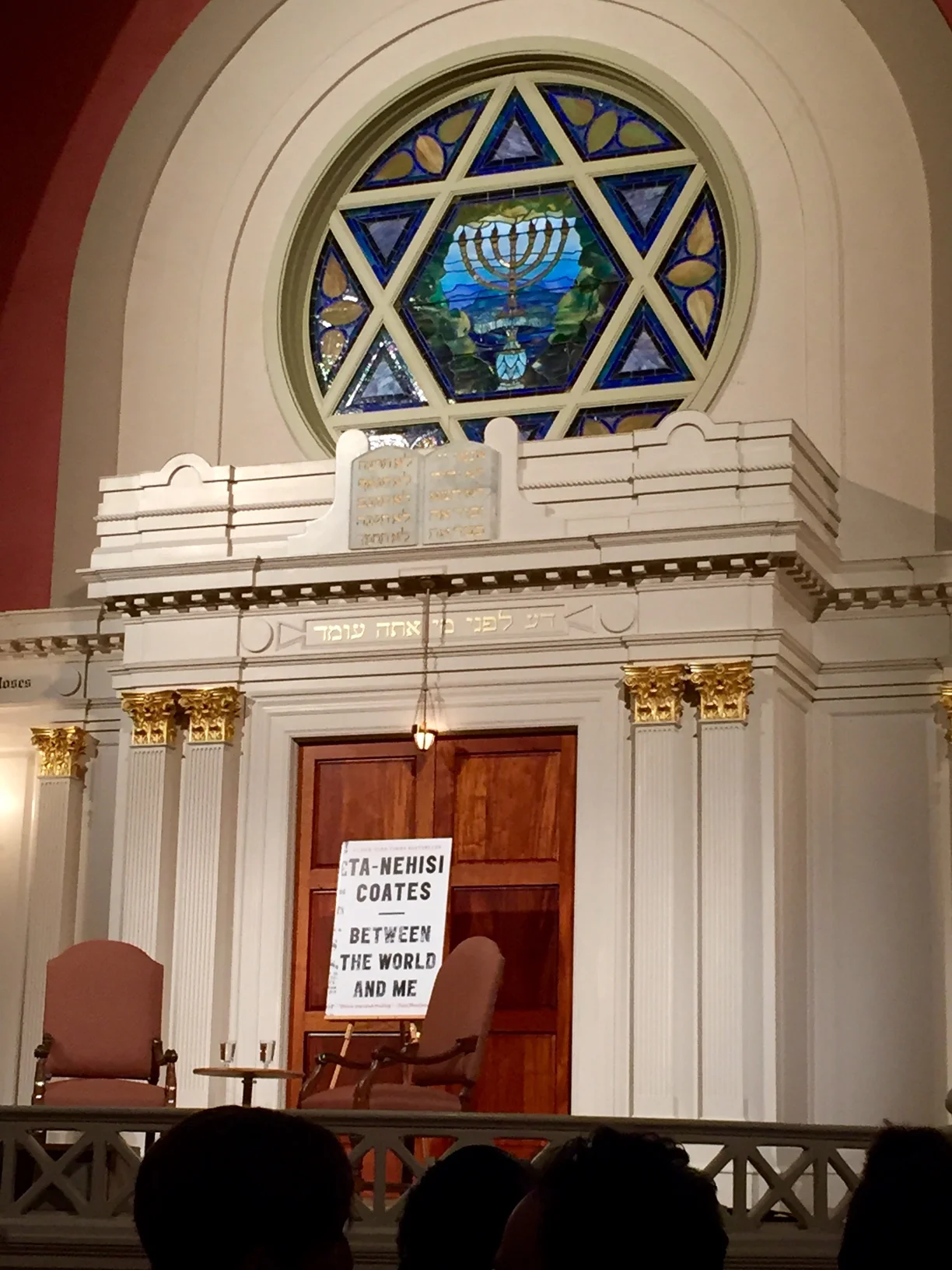
I took my seat, the closest to the dais I've ever had at Sixth & I, and took in the effervescent buzz of anticipation around me. Ta-Nehisi Coates was soon to take the stage.

Have you read any of Coates' work? He writes for The Atlantic (The Case For Reparations was an incredibly journalistic accomplishment; The Black Family in the Age of Mass Incarceration is in the Oct 2015 issue), has been published in the New York Times and has written two books. Between the World and Me is on the short list for the 2015 National Book Award, and Coates was just awarded a MacArthur Fellows grant.

Wednesday's talk was part of his book tour for Between the World and Me, his recently published letter to his son about the history and present of being black in America. Of blacks never having had full access to what Coates calls The Dream.

It is perfect houses with nice lawns. It is Memorial Day cookouts, block associations, and driveways. The Dream is treehouses and the Cub Scouts. The Dream smells like peppermint but tastes like strawberry shortcake. And for so long I have wanted to escape into the Dream, to fold my country over my head like a blanket. But this has never been an option because the Dream rests on our backs, the bedding made from our bodies.

The letter is, as he said in an interview, a literary construct, but Coates told us that he tried to be as unsparing in this book as he is when speaking with his son. Which is to say, brutally candid about his perspectives and confusion and fears, for blacks, America and his boy. 

He feels that in doing so, real trust is built, and I agree. He has a presence and authority that comes from mincing no words and buttressing his arguments with research and facts. 

Coates grew up in Baltimore. Looking back, after college at Howard University -which he credits as the watershed experience of his life- he believes it wasn't rage or violence that really explains all he saw and witnessed on his childhood streets. It was fear. 

Not being violent enough could cost me my body. Being too violent could cost me my body. We could not get out. I was a capable boy, intelligent, well-liked, but powerfully afraid. And I felt, vaguely, wordlessly, that for a child to be marked off for such a life, to be forced to live in fear was a great injustice. 

Coates' writing is so powerful. In print he often seems a hyper-intellectual firebrand. I love reading his work and admire him tremendously, but I wasn't sure what his in-real-life presence would be like. Would he seem prickly?

Not in the least. He is totally charming, affable, funny, warm, at ease and so very bright. I laughed, was brought to tears, and found myself repeatedly nodding my head in agreement or disbelief. It was an important night for me, and I enjoyed myself tremendously.

*******

Last night, T and I joined friends at Buck's Fishing and Camping (same place the Gabrielle Hamilton dinner was held; remember? I asked a three-part question!) for a dinner celebrating the release of Ruth Reichl's new cookbook/memoir, My Kitchen Year.

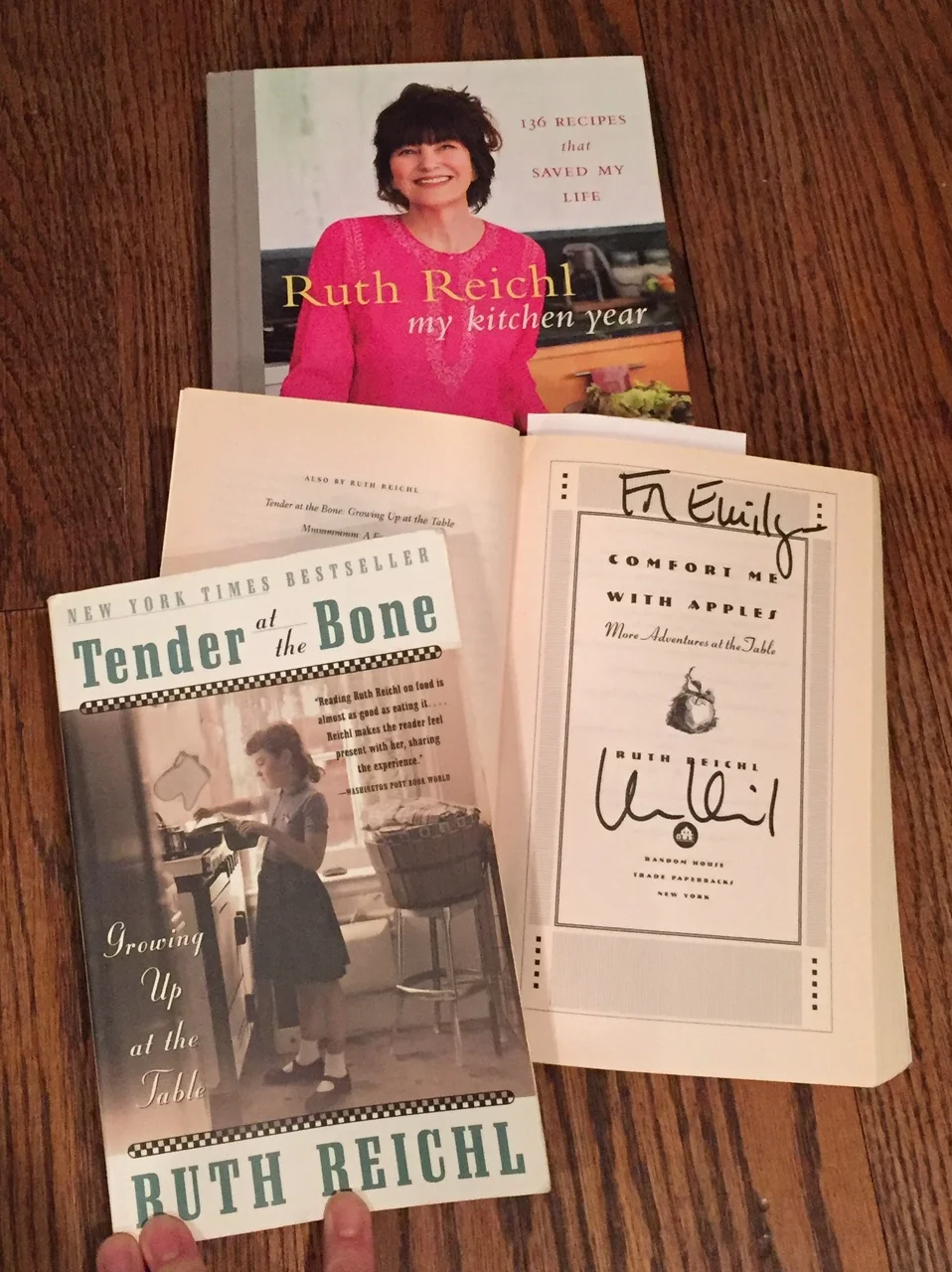
Long, long ago, I read two of Reichl's memoirs, Tender at the Bone and Comfort Me With Apples. I can hardly remember the details, but I remember feeling enveloped by her stories, her writing, the way she wrote about childhood, adulthood, food.

I thought she was a marvelous editor at Gourmet and loved her emphasis on publishing long-form food writing. Real, substantive, literary work. When Conde Nast suddenly and unceremoniously shuttered the magazine's doors in 2009, I was both surprised and deeply disappointed. At that time, Reichl was 62, and couldn't recall the last time she hadn't had a job. What was her identity without one?

She did what she'd always done when stressed or sad. She went to her kitchen and cooked. My Kitchen Year is the result. It's a simply presented book, 136 recipes dancing with stretches of Reichl's effortless prose. You feel you can make these recipes and do so successfully, and I believe that's Reichl's aim.

She wants people back in the kitchen because she knows what transpires when one cooks to nourish oneself and others. It's something along the lines of healing. At least it was for her. 

Of course I asked a question, which was along the lines of the place and future of food memoir in a time that often prefers soundbites, and later got to sit by Ruth for a while. She was gracious and lovely and signed not only my copy of My Kitchen Year but also the old paperback copies of Tender at the Bone and Comfort Me With Apples I'd pulled from my 'favorites' shelf as I ran out the door.

Thank you and why I write

I am overwhelmed, in the very best of ways, by the deluge of beautiful responses I've received since posting Do you know? last night. 

I will admit to a nervous hand clicking "save and publish," a shaky heart wondering how my words would be received.

What I hoped for was twofold: a refreshing sense of getting feelings off my chest and connection with you; perhaps you'd understand, know exactly what I meant, feel less alone. What I didn't expect were your generous notes of thanks and "Yes, me too!" and "This resonates so powerfully with me." 

Via text, email, the comments and even in person today, I have heard from you. You've told me that you felt a lump in your heart, your throat, behind your eyes as the tears welled. That you sat in silence and felt moved beyond expectation. That you feel what I've written is brave and eloquent and real. That you know and feel it all too.

What I want to say to you is thank you. 

I am not a trained writer, and rarely do I sit down with a plan. I sit down to write because I need to. It is a drive that comes from deep within. I can only explain it like that.

I write to understand, to question, to figure things out, to better know myself. I write to unearth and illuminate truth, to attempt to pull the masking veils from expectations -societal, personal- that are absurd, antiquated, harmful, unfair. 

I write to hold myself accountable. I write because I love words and stringing them together makes me soul sing.

I write to connect, to comfort, to bear witness to and to stand up for things. I write to laugh and to make you laugh. I write to record. I write to release.

And then y'all show up and make everything even better. I am humbled and thankful and full today. Thank you!