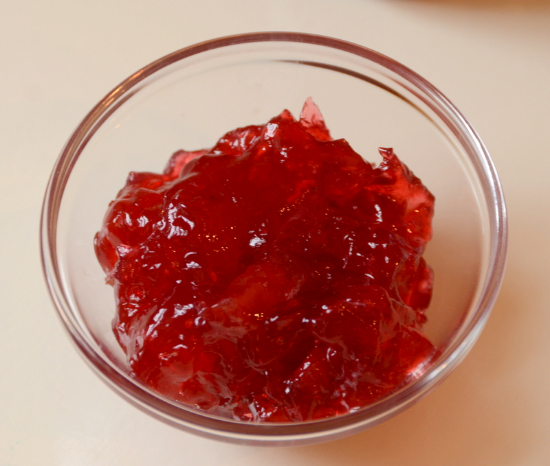
Currants in history: Barley-dew or Bar-le-Duc?
/A little more than two years ago, I resumed my station as a student. I could spend my life in one class or another, homework deadlines here, anticipating feedback there. That first class back was an online Food Writing course, and though the instructor was average, I found great connection with some of my classmates. I’ve told you about them before: Louisiana Lili, New Mexico Laura, Massachusetts Catherine; all talented and kind and funny women whom I am grateful to know.
Laura, whose heart sings amidst stacks of old books and internet research queries, is a fantastic food historian and often buttresses her stories with fascinating tidbits drawn from her searches into the past. She recently shared with our writing group a delightful essay on the mysterious barley-dew, a foodstuff whose very name was once invoked as possible punishment for naughty behavior by a friend of Laura’s, but which, in Laura’s ears, sounded magical. Indeed, as you’ll see, barley-dew is a confiture of epic work and love. And also currants.
I asked if she’d let me publish her essay here, and she generously said yes. I hope you enjoy it as much as I did. And because there is no chance I will ever choose to de-seed currants by hand using a goose quill, I worked up a new recipe that uses the beautiful rubies that are fresh currants but in a much simpler way.
Barley-dew
by Laura Shubert
A few years ago, a friend of mine told me that when she was naughty her mother would say, “If you’re a bad girl, I’ll feed you barley-dew!” My friend had no idea what barley-dew was, but she thought it sounded horrible.
I, on the other hand, was enchanted by the thoughts those words brought to mind. I envisioned early-morning light falling softly across tall, grass-like plants. I saw dew shimmering on heavy, ripe heads, moisture dripping languidly down ochre stalks. My vision then stopped abruptly and shifted to the more puzzling question of how to collect all that wet barley goodness? Thimbles? Clearly, barley-dew was a euphemism for some type of food, but what kind?
When I first began researching the elusive barley-dew, I found a Midwestern catering business that had it listed on their sample brunch menu. It did not mention what it was, only that they could serve it. I had found little else that described this foodstuff so I emailed the business but I never heard back from them.
A few months later, I found a 1940’s newspaper that detailed the menu for a ladies club luncheon. There it was: barley-dew! Alas, it was still a name without description. I set it to the back burner.
When I write, and get caught in tangled words and snarled sentences, I often take a little break and relax my mind with research that has been put aside. Just recently, while writing a piece on pudding, I found myself mired in a thick, eggy custard of gooey wordsmithing. I decided to leave the pud behind and launch myself into the magical and weightless world of surfing the waves of bytes and code
Pay dirt! Tucked away in the March 5th, 1969, edition of the Toledo Blade, in a column by William and Mary Morris called Words of Wisdom, was a query posed by JM. The questioner explained that in childhood her mother fixed cream cheese with currant jelly or jellied whole currants poured over it, and she called it “barley-dew” or “barley duck.”
The wise Mr. and Mrs. Morris explained that “barley-dew” or “barley duck” are regional dialect, or pronunciations, for “Bar-le-Duc,” a preserve made of currants or gooseberries. Bar-le Duc is also the name of the French town where the preserve is made.
It’s so very clear how Bar-le became barley and Duc, where the French pronunciation would leave the D silent, became dew. One mystery solved, but there was more.
Bar-le-Duc is no simple concoction of currant jelly that is then poured on a block of humorless white-squared cream cheese. Instead, it is known as the caviar of fruit preserves. Its origins reach back through history to the 1300s when monks from the town made the culinary decision to remove the seeds from the white and red currants that grew in the area and make a preserve known as Confiture de Bar-le- Duc. It became all the rage among European nobility, with Mary Stuart, Queen of France (and Scotts), calling it “a ray of sunshine in a jar.”
To produce this jam, the currants are removed from their stems and then, individually, each fruit is held between two fingers while the six to eight seeds inside are removed with a hollow goose quill. When done properly, the fruit remains completely intact, seedless and filled with pulp. The berries are dropped into boiling syrup to preserve color and flavor, and are reduced to a slightly thickened consistency.
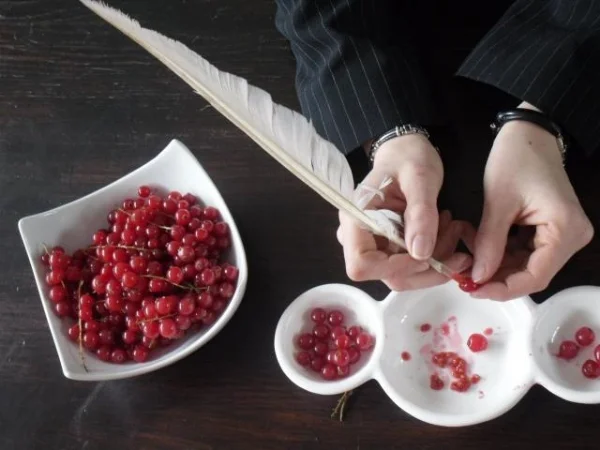
Merci beaucoup, mylorraine (http://www.mylorraine.fr/static/image/1359_Gastronomie-groseille-CDT%20Meuse_640.jpg)
By the end of World War II, those who chose to remove currant seeds by goose quill had declined, and by the 1970s there was a lone 91-year-old gentleman who produced the famed confiture.
Eventually the company was sold to Jacques Dutriez, who agreed to continue the traditional hands-on method of production. As the monks did so long ago, women called epepineuses (seed extractors) collect berries, remove the seeds with tapered goose quills and cook the jam in home kitchens with domestic jelly pans.
These women are paid by the kilo for seeded fruit and an experienced worker will prepare several kilos per day. Not surprisingly, a small jar of this meticulously hand-crafted currant jam costs upwards of $40.
I’ve been a bad girl. I need to be punished. Where’s the barley-dew?
Sour Cherry-Currant Confiture
makes 3 half-pints plus some for the fridge
Ingredients:
1 cup fresh currants, stems removed
3 tablespoons freshly squeezed orange juice, divided
5 cups sour cherries, pitted (if using frozen, don’t thaw first)
2¾ cups unrefined, granulated sugar, divided
1 small red apple, unpeeled, cored and finely diced
2 packets liquid pectin
Instructions:
Fill your canning pot with water, cover, and set over high heat. Do this first because it takes a long time to bring this much water to a rolling boil. Ready the appropriate number of jars and get out your canning funnel, ladle and such.
In a small pot, one-quart or so, put the currants, 1½ tablespoons of orange juice and ¼ cup of sugar. Turn the heat to medium-high and, stirring regularly, cook until the currants have burst, releasing their seeds. This won’t take but a couple minutes. Let cool a bit and then strain through a fine-mesh sieve, pressing down on the fruit mixture so that you get as much as you can but leave the seeds behind.
In a jamming pot, place the sour cherries, the rest of the orange juice, the rest of the sugar, the diced apple and your strained currant jelly. Set the heat to medium-high, stir regularly, and once the sugar has all dissolved, turn the heat to high and bring to an active boil. Cherries have a tendency to foam, so if that bothers you, skim it off.
After fifteen or twenty minutes, check the temperature. Is it around 216° Fahrenheit? Stir in the liquid pectin and bring the jam back to a rolling boil. You need this to reach roughly 220° so that all the pectin -natural from the apple, added from the liquid pectin- will beat the watery tendency of cherries and reach a set.
When the jam is ready -temperature, the wooden spoon test- carefully ladle it into your prepared jars. Wipe the rims, apply the lids and bands, and carefully place into your canning pot. Process for 12 minutes, remove and let rest on a kitchen towel for at least two hours.