When you teach your child to call you

As Oliver approaches the age of staying home alone for brief periods of time, I realized, yesterday, that I've not yet taught him how to call me should he need. He knows our numbers but was not versed on picking up the phone and using it properly.

He had no school yesterday and so we tackled tying shoes and making calls. 

A couple hours after mastering both, my cell phone rang. 

"Hello?"

"Hello," said a vaguely disguised child's voice. "This is Officer Penis. There is a thief going around town stealing everything. Have you seen him?"

"No," I said, "But I'll keep my eyes open."

"Thank you!"
****

Shortly thereafter, my phone rang again.

"Hello?"

"Hello. This is Major Asshole* calling. Are you on Spaceball 1?"

"I am not."

"OK."
***

Shortly thereafter, my phone rang again.

"Hello?"

"Hello," said the vaguely disguised child's voice. "This is Anus Poobanus 1. I have identified the thief as Silent and Swift Jack. He is wearing a black suit, that he stole, and a gray hat, a spy hat. He has brown hair. He goes into people's homes and steals everything and brings it all back to his lab and destroys it, or takes it for his own use, or analyzes it. Do you have any clues?"

"No, Anus Poobanus, I do not, but I will keep my eyes peeled."

"Why would you do that?"

"I mean open."

"OK, thank you."
***

This went on and on and on and culminated in our drawing a wanted poster for Silent and Swift Jack with this note: "If you see this man detain him for questioning and call Officer Anus Poobanus 1 at 1-800-Druidia."

I laughed all day but, as I prepped for my Dinner Club's arrival, ultimately forgot about Ol's antics.

Fast forward a few hours and my phone rings. Without thinking, I picked up and asked, "Anus Poobanus, is this you?"

"Um, what?"

"Oh, hi honey." It was actually Tom. The friend nearest me cracked up. I mean, who answers the phone with "Anus Poobanus, is this you?" and then it's NOT AP but one's spouse. 

When I told Oliver this story today, he fell out. Seriously, if he'd been driving, we'd have gone off the road. And then he told Jack and then laughed until they cried. 

My little one can now tie his shoes, make phone calls, AND reference movies within them. I'm proud.

*We are Spaceballs aficionados. If you don't know the Major Asshole scene, you should acquaint yourself with it! 

An encounter on the train

Just after 9am, I slide into the fourth car of the southbound red line train, between, what I quickly realize, is a quiet lull in her screams. Headachy, tired, energy and thoughts focused on the day ahead, I sink into the first available forward-facing seat (motion sickness is never what I need) and pull a slim paperback from my tote. 

As we roll away from the station, the child begins howling again, guttural, high-pitched wails that reverberate throughout our car. Such screams would always be dissonant, but they are especially so in this sleepy time, in this dim place. 

The screams are near, and as I click my head from twelve o'clock to ten, hoping my left peripheral can grasp some evidence of source, I see her. Two rows back, hair in tiny, ramrod straight pigtails, body sheathed in a turquoise winter coat. There is another parka-clad child -a sibling?- with similarly styled hair, and a shadow of a person attempting to corral them. English is interlaced with a language I cannot place.

Throughout the car, mostly full of solo voyagers in various stages of dress and wakefulness, eyes cast, subtly and obviously, towards the trio two rows behind me. Gawking. Avoiding. Disdaining. Worrying. Wondering. 

The woman- I gather she is she from the tenor of her voice- is so tall and thin she resembles a scarecrow. Her short-cropped hair is sheathed in a knit winter cap. She has given one child her phone, but that has provoked warfare.

One child beats the other -I don't use the word 'beat' irresponsibly- with the gifted phone about the face and brow. The woman screams and issues seating placements. "You here, you there." Always she keeps one encircled in a bony arm. The child forced from the embrace resists exile and screams louder. Frustration, anger, sadness, desire all wrapped into a vocal vortex emanating from her tiny throat.

The tension in the car mounts.

The woman changes tack- she begs, pleads, embraces both children, one gaunt arm per one robust child. Peace is not established. 

I have put away my book. I am aware that my heart is beating rapidly and that my mouth is dry. I want desperately to intervene, but can I? Would some foray into their trio be welcome? Offensive? Rebuffed? Based, simplistically, on the foreign tongue dancing around me, still I cannot place it, would I be making a giant cultural misstep? And anyway, what would I do, and how? 

I scan the car and take in others' coping mechanisms. Louder, perkier conversation with seat mates, ear buds quietly plunged atop pounding drums, baleful looks, disparaging glances. 

My stop is approaching, and the children have not calmed. I swivel over my left shoulder, and without thinking, look directly at the source of most of the screams. I smile at her, whisper "hi sweetie," and wave. As I'm sure my children would have, she pauses, musters a jagged inhale, overcomes her suspicion, and smiles back.

She is beautiful. Face full, pigtails standing at attention, most recent tears drying on lashes and cheeks.

"Would you like an orange?" I hold up a fresh satsuma, glistening with produce wax, and hold it out to her across the empty row between us.

The woman sighs, "Take it," she says with a fatigue I recognize. "Take it."

Gently, I move back, erasing the separative space. Cautiously, I lean toward the woman. Cautiously I ask if she is OK.

"They are twins. They do this to me all the time. Fighting, screaming. I am so tired. My blood pressure is high. I am a single mother to these girls. We are heading out."

Her hollow eyes, her willingness to share with me. She is on the precipice of bursting. Of not being able to handle even one more straw. 

I know this place. I have been there. More than once. If one doesn't have reason to be fully dressed and riding into the city at 9am, the drive is desperation. 

"You must be exhausted," I tell her, putting my arm around her shoulders gently. "You must be so tired. I have two as well. It is so hard." 

The little girls are making sweet eyes at me, and I at them. One tense moment has been diffused. I have always been grateful for those moments of dissolution. Those moments of reprieve when I can take a full breath. I hope this mother feels she can breathe a bit.

The four of us get off at the same stop. I will head to a conference that thrills my soul. I don't know where this family is going.

I kneel down and hold the hand of the one to whom I offered the orange.  I look into their eyes and smile. "Sweet girls, will you be kind to your mother? She is such a good mom. No hitting, just hugs, ok? Can you do that?" They smile and nod, and one peels a bit more rind from the orange.

I stand and look at the mother and take in her shell shock and exhaustion. I hug her tight to me. "I know you must be so very tired. Good luck, ok?" 

They walk toward one exit. Mine is in the opposite direction. I watch them for just a moment, brightly-colored parkas and orange peel and the halting gait of a stretched mother moving farther and farther away. 

I exit at 9th and G and think of them during the half-mile to my destination. Where were they going? What will they do today? Will they be OK?

Happily colliding worlds of Nanny at the AWP Conference

I don't know if I've ever told you much about Nanny and Papa's house. Oh sure, bits and pieces here and there. How it sat in both sun and dappled shade on a corner lot at Moss and Division streets. About Papa's blackberry patch out by the old shed, and the towering pecan trees in the side yard by the Duhon's house, and Nanny's flowers all over. 

Maybe I've told you that white wooden house was where my mom and her siblings grew up, and where Nanny lived for more than sixty years until she died there, in her bed, at the age of 92, Mom right beside her.

It's the house where I, in many ways, grew up too. It's where we used to shelter for hurricanes threatening Lake Charles because it had always withstood even the strongest ones. It's the home in which we gathered for countless Sunday lunches of spaghetti and roast, salad and French bread, tall glasses of Lipton iced tea, and pie or a cheesecake or Crown Jewel or Nanny's lemon-lime refrigerator sheet cake.

Perhaps what I've not mentioned is that the property included four or five apartments, some separate from the big house and others attached to but not part of it. Nanny and Papa let those apartments for helpful supplemental income, and when Papa died, Nanny continued to keep the places rented.

The extra money was great, but I also liked that Nanny seemed to attract some really special tenants who became much more than simply renters. At some point, the head of the writing program at McNeese, the university in Lake Charles, started sending graduate students Nanny's way. The early referrals became a self-perpetuating means of keeping the apartments full.

One MFA student, a thirty-something named Neil, approached Nanny fourteen or fifteen years ago, and asked if he could rent an apartment month to month rather than signing a year-long lease, which was her standard first-year requirement, due to some personal concerns. Never one to turn down any sincere ask for help, Nanny said yes. 

Neil stayed for eighteen months, and during that time became close to Nanny. She adored him, and although I didn't live in Lake Charles anymore and so never met Neil, I nonetheless felt I knew him. I knew that he met and married a wonderful woman and that while still in town, they had a son. Nanny loved getting to know his expanding family.

After Nanny died, Mom told me about the beautiful letter Neil had written her describing why Nanny had meant so much to him. His words rang familiar to so many she had touched and made happy over the decades.

Fast forward some, and because the Association of Writers & Writing Programs' (AWP) 2017 conference was slated for DC and I learned of this on the last day of early bird pricing last fall, I registered. When the schedule was announced, I flipped through it like the eager ever-student I am.

Thursday, February 9, noon: Beyond "Show, Don't Tell"
Neil Connelly, Cheryl Klein, Shawn Stout, Kekla Magoon.

Certain that Neil was the Neil from the white wooden house at 601 Division, I emailed Mom. "Yes!" she replied, "I'll put y'all in touch."

I reached out to Neil several weeks ago. He is now an English professor at Shippensburg University and has published eight books. "Neil, I'd love to put a face with the name I've heard about in such fond ways all these years. Might we steal a moment at the conference?"

"Emily, I write you from my office at Shippensburg, looking up at a picture of your grandmother, whom I adored." he replied.

I sat with his lovely note, looking around at the many photos of Nanny peppering my home, her vibrant smile the first thing anyone notices in any of them, and thinking of how special it was that yet another person (for there are many out there) in this big, diffuse world loved and missed Nanny too, and continues to keep her near. I was so touched, but I wasn't surprised.

This morning, after getting the kids ready for school, quickly pulling together a not-mom outfit, and shoving some pens, notebooks, phone charger, and snacks in my "professional bag," I hopped on the Metro and headed downtown, attempting to get there, check in, and make it to the first panel on time.

Being at AWP feels somewhat like being in Vatican City. You're in a small, densely-populated humming city-state: it's overwhelming, but in a way I like. 

The first panel was absolutely great, and then I texted Neil to check in. I'm in the Book Fair at booth 575, he replied. The Book Fair, let's say it's the Vatican within Vatican City, is not small, but sooner than not, I was at 575, sharing a smile and hug with a kind man who once lived in the apartment abutting Nanny's house. 

We found seats at a nearby table and reminisced. 

"Your grandmother and I used to sit on her back steps and talk. About tough stuff or nothing at all. And she would really listen, with no judgment."

That very trait, the true listening and hearing with no judgment or superfluous commentary, is one of the things I most loved about Nanny. I told Neil how much I missed Nanny still, and as I teared up, he said, "She's a person worth crying over." Isn't that a profound compliment? I think I'll remember that simple phrase forever.

He told me that once he moved out he continued to send students to Nanny but with this head's up: "You'll get a place at a good price, but you need to help Florence. Take out her garbage, check in on her, don't upset her."

Nanny took care of Neil, but he took care of her too, and I am so grateful for that. Imagine if we all looked after each other in such ways.

When Neil's first son was born, he and his wife would take him to visit. "To this day when Owen eats a peppermint patty, he thinks of your grandmother's house and how much he liked it there." 

I do the same. So do Jack and Oliver. Nanny always had York mints in the middle drawer of the buffet in her living room, and usually Starlight mints as well, those hard white-and-red peppermints. Maybe some Werther's too, but not as regularly.

"That front room had such great natural light. And high ceilings and those gauzy drapes in the windows." And like that I was back there again, sitting in the recliner across from Nanny's, watching the birds come to the feeder suction-cupped to one of the windows sheathed in translucent fabric, rolling around on the ancient carpet and feeling the familiar highs and lows of the slightly buckled wood floors underneath.

I remember when Jack was little, or was it Ol?, he'd lay quietly on that carpet and run his hand back and forth across the pile. Feeling, noticing, exploring. 

"Once, early in my and Tom's relationship," I told Neil, "I took him home to Lake Charles for a visit, and while there, my parents were trying to figure out how to affix Nanny's recliner to a wooden dais. I can't recall why, but it needed to be sturdy and firmly attached. Tom is an engineer so he got right to helping, and I remember thinking he'd really passed a test. He could see that we all adored Nanny and wanted to do anything for her, and he jumped in to do the same."

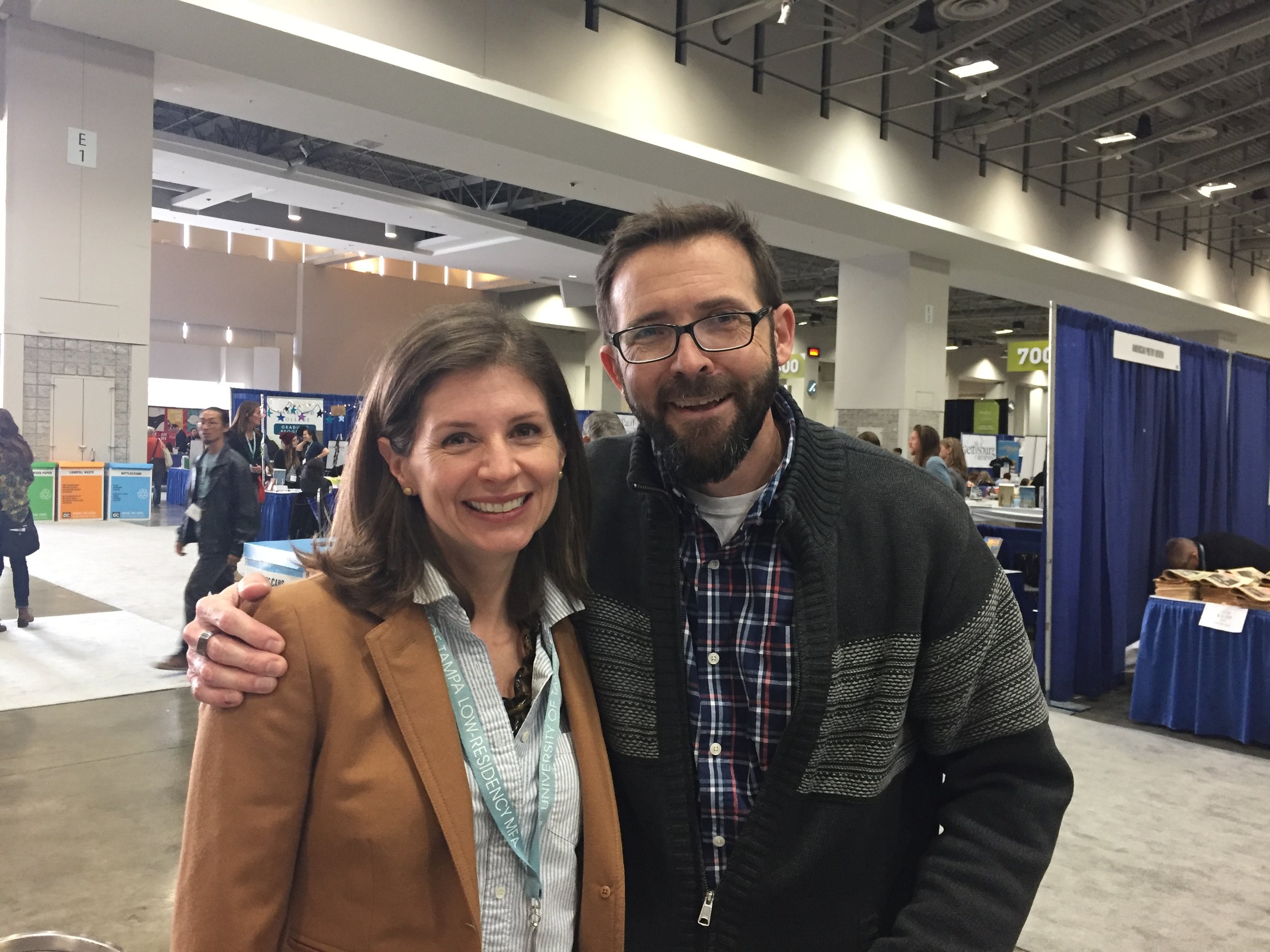
The time came to go our separate ways, and I asked if we could take a picture. Though I don't believe in an afterlife, I have to think that in some way, Nanny saw us and smiled her radiant smile.