New Year, New Em-i-lis

It is an abnormally warm winter morning; 63° F in Maryland on January 12? And nearly 70 yesterday. Meanwhile, Australia continues to burn, and the news about the Ukrainian passenger plane shot down by Iran remains shrouded in suspicion, smoke, and mirrors. trump has been impeached by the House, but the Senate is unwilling to hold a fair trial.

2020 is not off to an auspicious start, and I have been sitting with a definite sense of unease and fatigue since the proverbial ball dropped. In reflection, several things have crystallized.

  1. Facebook, while so pleasurable and connective in many ways, is not a positive force for democracy or educative purposes. Mark Zuckerberg is a bad actor, and his policies do not support a site that bridges or teaches. Rather, he turns a willfully blind eye to the many ways his site not only allows but spreads mis- and disinformation, and I can no longer be a part of that. With mixed feelings, and as many of you know, I’ve just bid Facebook goodbye. For now I’ll stay on Twitter (@em_i_lis) and Instagram (em_i_lis) should you wish to connect on social media.

  2. My writerly mind and hand have felt increasingly shriveled, a reaction, I believe, to the stress of life post-2016. Nothing feels as safe, and I see so many of us hunkering down and in, searching for people and spaces in which we can vent, breathe, worry, and support. And yet I attribute writing (and teachers and mentors like Jena, Dana, Anne, Laura, CLJ, Denise, Leah, Margaret, and Sue Ann) to freedom. To so much of the woman I am today. To the ways I’ve shrugged off old burdens and others’ expectations that didn’t resonate with who I really am. To the voice and sense of self I have now. It seems clear that I need to return to this space and reclaim it, reshape it, repair the flaking silver from its back so that I see my most accurate reflection when I peer in.
    As Margaret Atwood said, “A word after a word after a word is power.” For me, for all of us.

  3. Every single one of us needs to get busy in support of this November’s election. Winning the Presidency and Senate and holding the House will require all of us to donate, call, text, knock on doors, register voters, and urge people to exercise the privilege we each have in our vote. And let me be clear, I believe, firmly and completely, that we have to gain hold of all three, the White House, the Senate, and the House, if we are to right our sinking ship. I don’t want to live in a single-party silo country, but the GOP has completely lost its way. With the exception of Justin Amash who had to leave the party behind, the GOP has shown that it cares not for our Constitution, cares not about representing the totality of the American people, and cares not for the rule of law. America is NOT and should not be a heteronormative, white, Christian country.
    As you’ve all heard many times, Benjamin Franklin, exiting Independence Hall the day the Constitution was adopted, was asked, “Dr. Franklin, what do we have, a monarchy or a republic?” He replied, “A republic, if we can keep it.” 

Keep it we must. Keeping it means doing more than tweeting and posting. It means real footwork, a lot of time, a lot of effort, and a lot of determination. It means being deeply educated and being willing to talk and share knowledge with others, to fill the holes left in the wake of pitiful excuses for “news” outlets like Fox, of weak public education, of willful ignorance, and of bigotry, hate, and pretty much every -ism you can think of. We must, each of us, be informed and remain open-minded. We must seek candidates to support but also hold the big picture front and center. Intra-party purity tests only benefit the opposition (except re: Tulsi. She is a terrible candidate who has failed to do her congressional job more than 87% of the time, and she isn’t a Democrat).

Long story short, let’s get to work. In addition to my activism, I am relaunching Em-i-lis as a small contribution to the Resistance. My goal is for this space to educate and inspire and foster a community of energetic, democratically-minded peers and also to entertain and chat with you.

Here you will find:

  • a weekly round-up of articles, speeches, etc that feel critically important and contribute to Em-i-lis’ new mission;

  • contributions by really incredible thinkers and writers who are regular people like you and me, people I am lucky to call friends and who are doing the work we must all do;

  • ways you can get involved in various campaigns, get-out-the-vote efforts, and so forth;

  • humor! levity! comic relief! my cats! general spawn-based shenanigans! travel, theater, and book ideas.

If Em-i-lis is no longer for you, I wish you all the best. If you want to join me here, please subscribe! You’ll have to confirm/verify your email, so please check your inbox and/or spam box to ensure you click through the link you receive. You’ll only hear from me once daily at the very most- after I post, a Daily Em-i-lis is emailed out the next morning. My goal is 2-3 posts per week.

Please be patient as the site undergoes some renovation, and keep in mind that while it is optimized for mobile, the best functionality and viewer experience is via desktop. Please let me know what you like, don’t like, want more of or less of. And as always, thank you for your friendship and support!

Let’s do this!

2019 heads out

The boys have the flu, the real, stinking flu, and Tom and I bidding the last of our very crappy colds adieu. He just got home from work, and I can hear him hacking as he walks up to the door.
Several of my dearest friends are dealing with seriously challenging stuff, and our country is, in my opinion, not doing well.

accurate

accurate

I don’t feel terribly festive, but I am trying to focus on all that I am grateful for and look ahead to the enormity of the work that needs to be done in 2020 with balance and hope.

I wish you all the best in health and happiness. Cheers!

Women, violence, anger, silence, enough

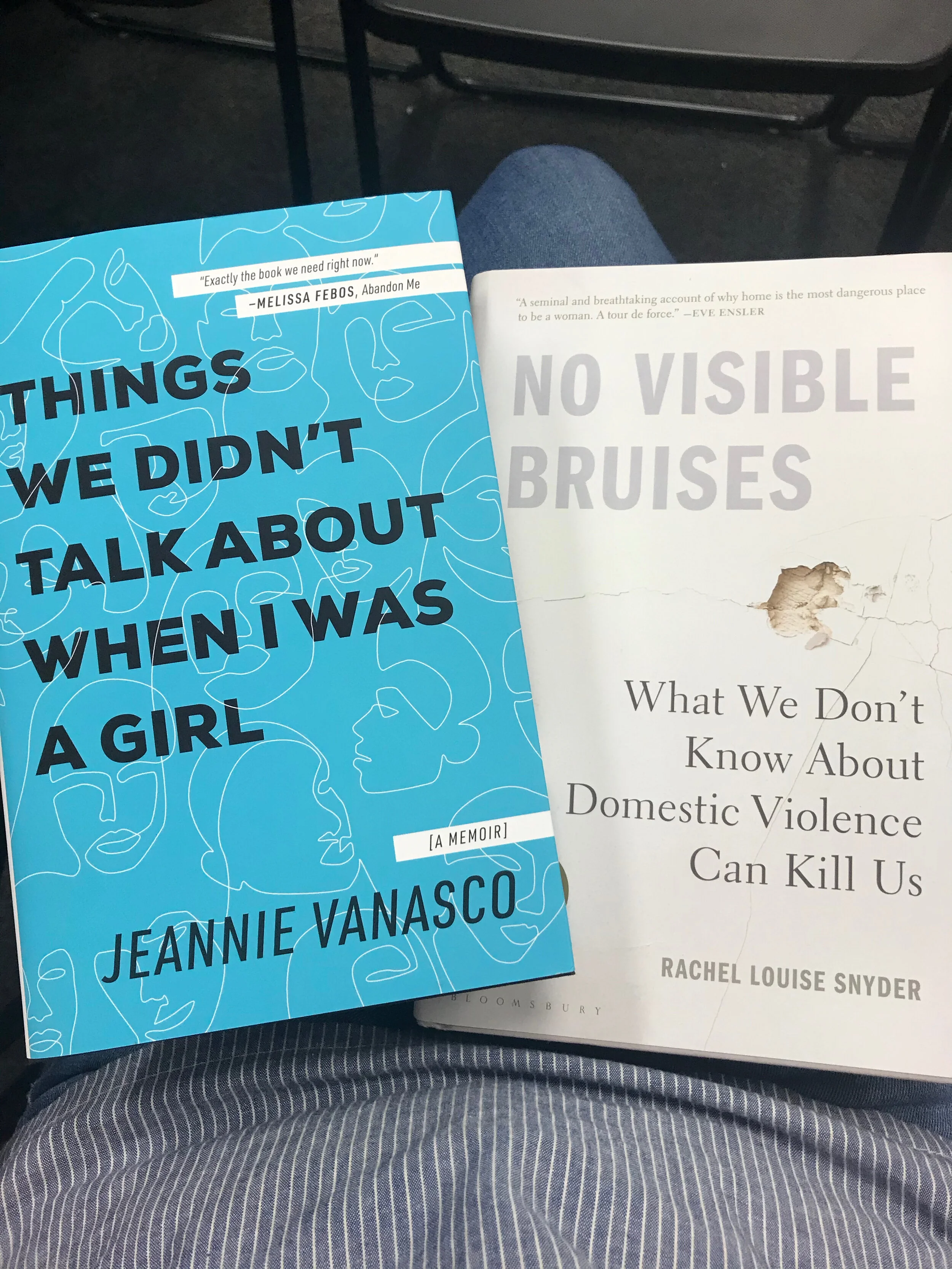
Have y’all read No Visible Bruises: What We Don't Know About Domestic Violence Can Kill Us by Rachel Louise Snyder? It’s not particularly uplifting, but it’s a powerful, meticulously-researched read and, in my opinion, a really important one. In the era of #MeToo, rampant abusers like Harvey Weinstein, trump, and so many more, Christine Blasey Ford’s powerful, truthful testimony (to no avail), draconian infringements on reproductive rights, and desperate vies for power and control, No Visible Bruises is crucial reminder that toxic masculinity, ignoring women, and the silence that comes from shame, stigma, and fear are an often lethal combination.

The longer I live and the more I read and listen, the greater my shock and gratitude that I have never been sexually assaulted. Harassed, yes, but even those experiences seem rather minimal in the grand scheme of things. My luck feels like some sort of massive break in the universal struggle of women. How sickening that I feel so rare in this way, for what does that say about what so many others endure?

In this year since one of my closest friends and I sat speechless and teary though the Blasey Ford and Kavanaugh hearings, I have thought about the ways women persist. How we pacify and quiet down and overcompensate and protect. How we too often sacrifice and diminish ourselves for the benefit and comfort of others, including other women and weighty social norms.

Enough.

This afternoon, I went to Politics & Prose for an author event: Jeannie Vanasco (new to me) would be in conversation about her new book, Things We Didn’t Talk About When I Was a Girl, with none other than Rachel Louise Snyder. I brought Snyder’s book, bought Vanasco’s and a London Fog to sip on during the talk, and settled in in the second row.

IMG_6880.jpg

I am so glad I went. Both women were so utterly real. So human and multidimensional and honest. They weren’t there to show off or curate their public personas or even, it seemed, to sell books. Both were there to think and reflect and educate and connect. Jeannie expressed mixed feelings and even a bittersweet confusion over why her friend, by all accounts a dear friend, did one exceedingly bad thing and to her. Rachel expressed anger and frustration, that which so many of us rightfully feel.

An older woman stood up to note that Kavanaugh’s behavior during his hearing was excused as righteous anger over being accused. I thought of Brock Turner being let off because he “has a bright future ahead of him” despite the fact that he raped an unconscious girl behind a dumpster. Another woman, younger than I, stood up to wonder if her anger at her horrifically-abusive father-in-law was ok even though he’s dying of prostate cancer. “It seems karmically right,” she said.

After meeting and thanking both Snyder and Vanasco, I clasped my now-signed books to my chest and shyly approached the woman with the sick father-in-law. “Excuse me, I said,” and she turned to me with kind eyes. “I think you have every right to be angry. I hope no one is shaming you for what you feel.” We talked for a few minutes, and her pain was so palpable. Her marriage is in dire straights in large part because of all the trauma perpetrated on her husband by his father. I squeezed her arm several times and wish I’d offered a hug. I saw her waiting by the bus stop as I drove out of the P&P lot and I hope she will be ok.

On my way home, I thought again, back to last year. I found this piece that I wrote just after the Blasey Ford-Kavanaugh hearings and thought I’d share some of it with you.

The powerful shrug of white male entitlement and anger that blew over Washington yesterday still hangs in the air, elbowing out the likelihood that Dr. Ford might truly be heard.

After dropping my children at school, I return home, slip my favorite women’s empowerment tee over my tense shoulders, and hastily draw my umpteenth protest sign—always crafted from foam core with different but equally fiery messages scrawled in black Sharpie Magnum marker on each side. This one turns out to be a favorite, with one side depicting three tearful female faces with blood red duct tape over their mouths and, below them, STOP written in thick letters. I grab the see-through mesh protest backpack that has accompanied me to every rally I’ve attended since the Women’s March in 2017: like the suitcase a near-term pregnant woman keeps close at hand, it is always at the ready. Since the election, there have been so many opportunities to use it.  

I call a cab and head to an 11:00 am gynecologist appointment made months before I knew who Christine Blasey Ford was, certain that I’ll have plenty of time to make the protest at the Capitol to fight Kavanaugh’s Supreme Court nomination. It begins at 1:00.

On the way downtown, I call my mother. We are both weepy.

“Mom, how can they ignore this? How can they want to appoint this man? I have to do try and do something.”

“I know. It is awful. Thank you for going, honey.”

As we hang up, the cab arrives at my destination. 19th Street. The driver, a man, kindly says, “I have sisters, a mother, daughters. In my country we respect women. I am so sorry for you feel. I am on your side.”

“Thank you, sir. Thank you so much.”

I’ve  known my gynecologist for more than a decade. If she reaches five feet tall, it’s only just, but her presence is formidable. She delivered my second son, helped get me the medication I needed during a difficult postpartum period, and is a magical combination of mother, sister, friend, and role model. We have a history of connection and mutual respect, and in her I have long seen manifested the strength and sturdiness I admire and actively work toward.  

As eager as I am to see her, I’m worried: She’s always running behind and I’m desperate to get to the Capitol. When I sign in at 10:50, I notice that the 10:00 patient still hasn’t been seen. A quiet jolt of dread stirs my stomach. The receptionist assures me it’ll be just a half hour wait. I take my seat, start charging my phone, and try to breathe deeply. 

Thirty, forty, fifty minutes pass, and I’m furious and frantic. I feel my blood pumping, my armpits sweating, tears burning hot in my eyes as I try to swallow them back. I hear myself demanding to know when my turn will come.  

I have to be somewhere. It’s important. Please.

I’m encouraged to give a urine sample.

 An assault victim bravely stood up yesterday, strong and sincere, scared and quivering, on behalf of millions. I want to stand beside her, literally, figuratively, but instead I’m being asked to pee by a nurse buying time for an unconscionably late doctor.

I wipe and pee and wash and breathe. I am taken back to the doctor’s office to wait some more. The tears aren’t threats anymore; they are actively marking my face and my shirt, and I think of my sign, forced to wait patiently by my mesh bag. Silenced women turned on their sides and shoved between chair and wall to wait. To wait until it’s their turn. They don’t know when that will be. If it will be.  

At well past noon, the doctor walks in.  My irritated posture and blotchy, damp face greet her. Because of our history, I stand up to hug her, and then am crying hard, as if I needed comfort and she was the first available. I haven’t seen her for two years. She doesn’t understand why I’m crying. Do I?

She asks if I am ok. I try to explain. I NEED to get to this protest. The need is primal, intense. I can’t articulate it clearly. I am angry that you’re making me late for something that feels so important, I want to scream.

 She surmises that I have been a victim of assault and that my history is bubbling up in the wake of Ford’s coming out.

 Her words anger me. I have never been assaulted. Even this feminist who raised a daughter who is now one of the only women in her engineering firm’s medical group seems unable to understand.

I am not crying for myself. I’m crying on behalf of women: those who have been assaulted, and those who haven’t. Those who have been ignored, demeaned, belittled, shrugged aside, seen but not heard, considered only in terms of their breast size or skirt length. Those who have been stolen from, whether their virtue, their ideas, their goodwill, the very things that we’re told make womanhood such a vaunted status. I am crying because I’m coming to think all that may have been a suppressive crock.

I am crying because a woman to whom something terrifying and intrusive happened decades ago now has two front doors in her home in case one is blocked and she needs to escape. I am crying because instead of applauding and honoring her courage, a cadre of white men actively seek to undermine and discredit her. These men want to give one of the biggest possible prizes to one of their tribe. I am angry. These tears are of anger. And I want, need to be giving voice.

“Does protesting make you feel better?,” my gynecologist says. “I admire that you’re involved, but is it healthy? I tend to put on classical music and bury my head in the sand.” 

I get that. But it’s not the way I operate.

…I’m finally outside and immediately see my friend, who’s meeting me.

In her I see a mirror image. She is floored when I tell her that I felt judged by my doctor.

 “What? We ARE angry,” she snorts, and I am grateful.

I tell her about a book I have been reading about women’s anger and how it often manifests in ways that aren’t “masculine.” We cry so that our anger is palatable. We cry so that men will see us as in need of protection, which safely perpetuates gender stereotypes, rather than as mad, hysterical women, which might make us look as if we think our anger is as valid as theirs. Anger crying is, I think, both a learned behavior and a way of subverting the system.

Enough.