
The Girl in the Spider's Web: a review, no spoilers

A bit of history: the Millennium trilogy

Did y'all read The Girl With the Dragon Tattoo and/or any of the subsequent two works in Swede Stieg Larsson's Millennium trilogy? I loved and devoured each book (the final two being The Girl Who Played With Fire and The Girl Who Kicked the Hornet's Nest) and waited with baited breath for the Swedish films staring Noomi Rapace (who brilliantly portrayed troubled, punk, genius hacker Lisbeth Salander) and Michael Nyqvist (a perfect Mikael Blomkvist, a Swedish journalist).* 
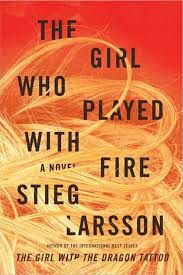
What did I love so much about these books? Where do I start?! 

The entertainment value is off the charts. Are Larsson's books National Book Award winners? No, probably not. Do they hook you early and keep you racing through the pages, one after another into the wee hours of the night? Yes. Emphatically yes! 

In the vein of top-notch Swedish crime writing, the books in the Millennium trilogy are well-written and suspenseful and the characters complex and well developed. Full of fault and foible but also brimming with courage and authenticity, the protagonists, primarily Lisbeth Salander and Mikael Blomkvist, are characters that you can't help but love and root for. The antagonists are sordid and gross, individuals who are sick, weak or who've sold their souls in a lusty chase for power or revenge.

But their match-ups are never simplistic, dull black-and-white affairs. On the contrary, you often hang by a chilling thread.

Larsson, a Swedish journalist who focused on right-wing extremism, wrote these books in his spare time. Just before his untimely death in 2004 from a heart attack at the age of 50, he apparently reached out to several publishers. The Millennium trilogy was published posthumously, starting with The Girl With the Dragon Tattoo (Larsson's title in Swedish was, simply, Men Who Hate Women) in 2005. It quickly became a worldwide sensation, and the third in the trilogy, The Girl Who Kicked the Hornet's Nest, was the most-sold book in America in 2010.

The Girl in the Spider's Web

After Larsson's death, his widow (by Swedish common law) and his father and brother (with whom, it's purported, he was somewhat estranged) disagreed vehemently about who had rights to Stieg's work, that already published and that found in his files. 

Discovered was what many consider the next book in the Millennium series. But this outline is not what Swedish journalist and crime writer, David Lagencrantz, uses as the foundation for his attempt to carry on the Millennium series: The Girl in the Spider's Web. Indeed, Lagercrantz did not have the blessing of Larsson's widow, Eva Gabrielsson, but only that of Larsson's father and brother.

In any case, as soon as I saw that Lagercrantz's book was out (via the Sunday New York Time's book review), I ordered it. Nervously but enthusiastically. 

If you bothered to read Scarlett, the sequel (that word in this context drips off my lips with disdain and dramatic air quotes) to Gone With the Wind, you will fully understand my nervous skepticism about Spider's Web. Hell, if you loved Raiders of the Lost Ark and were sure that your memory that The Temple of Doom was horrible beyond belief was wrong and so watched it again to check yourself, only to find that you again wasted two hours of your life, you will also get my worry that Lagercrantz's effort would fall terribly short.

Two days after placing my order, I ripped open the just-delivered Amazon box and jumped in. One hour ago, not a week after said box-ripping, I finished the book. 

I am so sad to have done so. While Lagercrantz's understanding of Lisbeth Salander seems incomplete, his portrayal of her disappointingly unfamiliar in some respects, and several elements of this story entirely too neat and tidy, Spider's Web is, overall, a fine continuation of Larsson's trilogy.

I had trouble putting it down, missed it when I wasn't obsessively reading, fell back in love with Blomkvist, and was on the edge of my bed more than three times. We meet an important character who's only mentioned via memory in the previous books, and we learn a good deal more about Salander's tortured past than Larsson shared.

Salander is not the main character in this book. Instead, Blomkvist takes center stage, perhaps because Lagercrantz has a better feel for him. The Larsson to Lagercrantz transition in writing Blomkvist is the most seamless element of Spider's Web, in my opinion. Lagercrantz's new characters are, for the most part, well-developed as were Larsson's which is a proud feature of Scandinavian crime writing as I understand it.

I didn't find this book as bullet-proof and tight as Larsson's, and the Knopf print-run from which my copy came had at least three typos which always drives me bonkers. But overall, I fully enjoyed living with the indomitable Lisbeth Salander and the sexily imperfect yet honorable Blomkvist for a few days more.

I won't be disappointed if a fifth book is offered to us sometime in the near'ish future.


*If you don't want to read the books but do want to know the stories, please DO NOT under any circumstance see the American cinematic effort in which Rooney Mara and Daniel Craig attempted but failed to inhabit the rich characters of Salander and Blomkvist. You must, instead, see the Swedish films which are brilliant and subtitled.
In sickness, in health, in school

I'm fully prostrate on the couch in my serene front room. "Because it's your one nice room," the kids always answer when I ask why in here I don't want them acting as if they're on a playground. They're correct, relatively speaking. It is my nicest room, the cleanest and most adult beyond the kitchen.

Real art hangs on its walls. Books with grown-up fonts marking their spines remind me of all I've read and loved and been changed by over the years. Nicely framed photographs, a library case that we use for wedding china and stemware, and even an antique demilune table that I spent years searching for give this room a mature, somewhat elegant feel that's largely missing in the rest of our home.

Our other rooms are more practical and comfortable for a family with young sons, and, by and large, I love the commingling of New York Times sections with swim noodle light sabers, a glass vase of flowers sitting next to plastic Melissa & Doug placemats, a cat tower weighted down by cartons of Zoobs and MagnaTiles. It's a mess but a loving, lived-in one.

I can see all that from where I now lie, in a filtered-sun spot next to a snoring pug. I like the proximate remove; even though our house isn't large and the floorpan is contiguous (which means the boys can literally run circles around the house), I don't spend much time in here. My parents had a room like this, in the house in which I grew up. It had a formal couch, a piano and pale carpet. We never went in but I always loved it. It felt clean and quiet and just slightly distant.

I likely wouldn't be here right now if I weren't tuckered out by a great but wildly busy week and the cold I caught from Tom during it. I feel like such tired crap. Being sick is not a strength of mine, but I'm trying to go with it today because I do need some rest.

A most wonderful friend stayed with us Monday-Wednesday and she and I ignored reasonable bedtimes to take advantage of the fleeting time together. Then the book events on Wednesday, a play date yesterday and then, last night, Back to School Night for Jack, my fourth grader.

It's almost worth being under the weather today to get to bask in quiet gratitude about the school J and O attend. I could not feel luckier, and I mean that. 

Jack's teachers are, again, remarkable, representing Quaker- and best, most current educational- values at their very best: "Whether it's math, baseball or something within themselves, we want the kids to know that all of us are always working on something." 

To make the myriad challenges of growth normative is such an incredible gift for a child. Wouldn't it have been amazing to hear, for all us who never did or did too late, "everyone is always working on something" before we started intensely comparing ourselves to others? Before any deleterious senses of self -I'm not as smart, not as athletic, not as capable- became too entrenched? 

The teachers also said what a gift it was to teach at a Quaker school because when an educational institution's goal is to value the unique inner light in each child, it allows them to meet the children where they are as individuals, honor what about each makes him/her special, and assess growth based solely on that child's starting point. 

Math is taught not only via paper-based algorithm work but also through literature and manipulatives. Reading is honed by all reading the same books and discussing them in groups and through drawing and journaling but also by allowing each child to choose the works that immediately excite them as well as requiring kids to read a book of their choice in several different genres.

There is art and science and laughter and play. There is regular P.E. and recess and both Spanish and Mandarin and both chorus and music. There are planners and lessons on time management and community involvement and service work. There is time for creativity and dreaming. There is a profound respect for childhood that pervades the campus and the curriculum, and I am inordinately grateful. 

It rarely hurts to ask

Y'all may have heard me opine that it never hurts to ask. I mean it, the older I get the more I believe that little can be lost (and actually, much can be gained) by simply asking, politely and earnestly, that about which you wonder. Also, gratitude. Giving thanks goes a long way.

A minute example are the espresso cups and saucers I once admired at my family's favorite Italian restaurant in Houston (growing up in Lake Charles, we had to head to Houston for most ethnic food and foreign film experiences) and shyly asked our lovely waiter, an older, silver-haired man who had the most gracious and charming disposition, if I might be able to purchase a set.

He wrapped them up lovingly, and I still have them all twenty years later. Six porcelain cups painted with scenes from six magical Italian cities, and sturdy saucers to seat them atop.

I have a water carafe from a restaurant in an Italian hill town for exactly the same reason, although the charming waiter there was much younger.

Back in January, I read a Modern Love essay in Sunday's New York Times that really struck me. I loved the way it was crafted, and elements of it resonated deeply with slivers of my own life as they were then. 

A few days later, still thinking of that piece, I googled the author (Ellen Urbani), found her website, emailed her a note of admiration and thanks and rather imagined that was that. 

Imagine my surprise when she wrote back and when our correspondence continued. Imagine my delight when I asked if, during her book tour swing through DC in the fall (her second book, Landfall, was just released a few weeks back!), she might want to teach a personal essay writing class. Imagine that this morning, when I opened my front door to Ellen and we hugged and she came in to teach class, that I was awfully glad I'd asked.

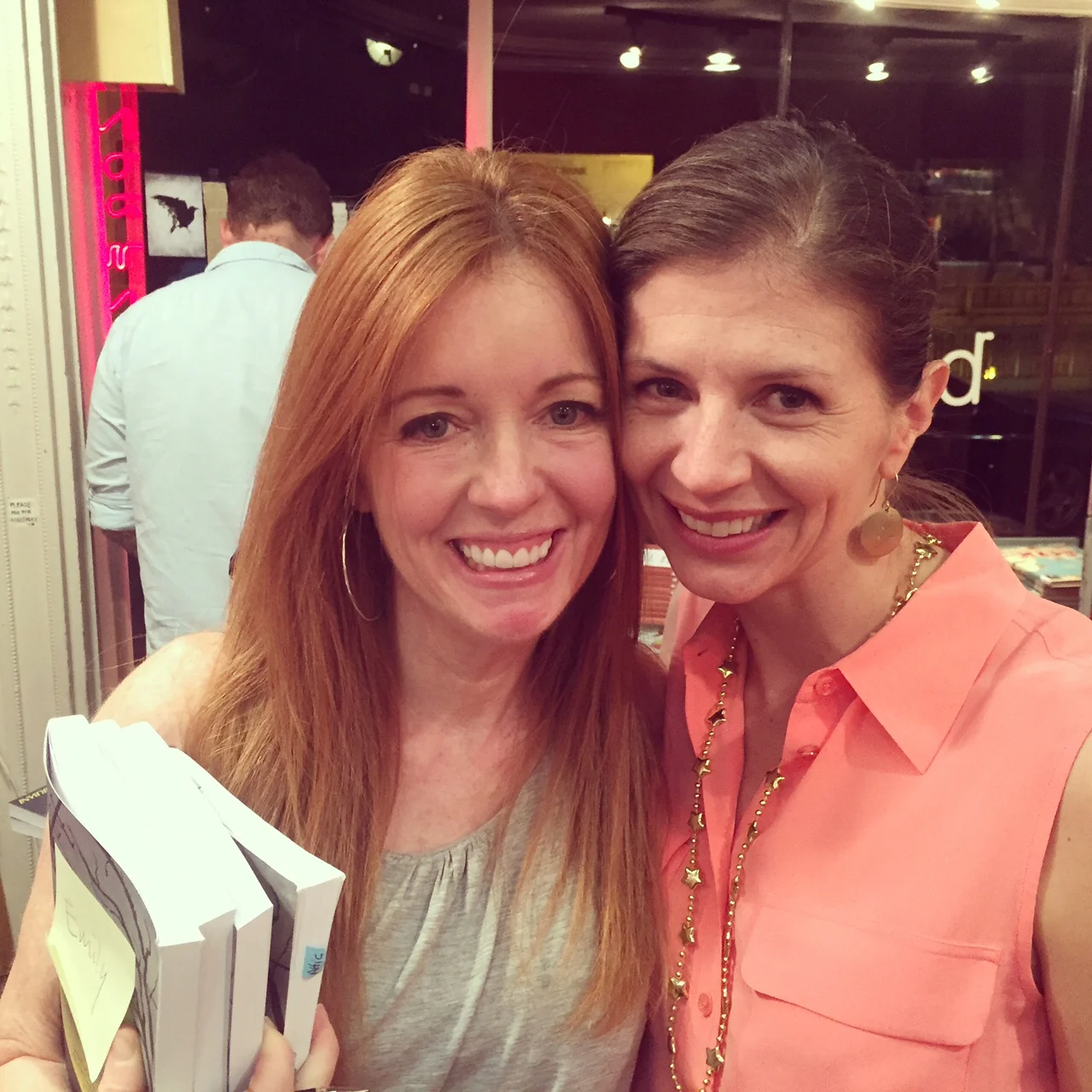
A few writer friends and I sat around my table and ate and laughed and learned from this loveliest of women who generously spent two hours of her busy day with us. And tonight, I heard her present her book, and we hugged again and snapped a pic, and as I drove home, I smiled up at the beautiful sliver moon and was reminded that the world is full of possibilities. Sometimes all you need do is ask.